
It is ironic and fitting that Rylstone contains the word stone. Fitting because stonework is Rylstone’s most impressive architectural feature. Ironic because no one has yet proved how Rylstone got its name, though that didn’t stop one writer declaring in 1884: ‘it is to the extent and quality of this material that Rylstone owes its name’.
Numerous newspaper articles in the late 19th century praised Rylstone’s solid public buildings and the excellent quality and colour of the sandstone, ‘procured with little quarrying from the neighbouring hills’. Enough reason to enter Rylstone stone in the Sydney International Exhibition at the Garden Palace in 1879. And win first prize. Rylstone churches, business places, government buildings and various residences were built of random rubble sandstone quoined with dressed sandstone blocks, thus creating the attractive townscape that we see today.
In the second half of the 19th century, as the country became richer from wool and gold, Australians became aspirational and the government magnanimous. One concern was law and order, especially in rural districts and on the goldfields. That’s when most court houses were built. 130 of them, including Rylstone court house, were designed and supervised by the Colonial Architect James Johnstone Barnet (1865-1890), or at least by his underlings. He wanted the local court to be a seat of authority, to symbolise the strength, elegance and permanency of the law. It’s no surprise that he chose sandstone for Rylstone.
When it came to local court houses, one writer for The Empire highlighted the inequality between small, prosperous bush towns with little disorder and gold-field towns with populations in the thousands. Comfortable, solid premises in sandstone at Rylstone compared to ‘weatherboard shells…utterly inadequate’ at Gulgong. Despite Gulgong sending more money to the treasury, Rylstone’s rich local pastoralists in parliament had more power.
There’s disagreement about what year the court house in Louee Street was built. Several sources, including nswcourts.com.au, say 1870; Peter Bridges who wrote Historic Court Houses of NSW says 1871; the commemorative plaque on the building says 1872; however the most credible year is 1873. On 24/12/1873 the Sydney Morning Herald reported, ‘This building [the court house] was completed a few months back’. The previous year, on 10 December 1872, W Jones & Son were declared the successful tenderers for furniture and fittings. A few weeks is hardly enough time to fit out a court house.
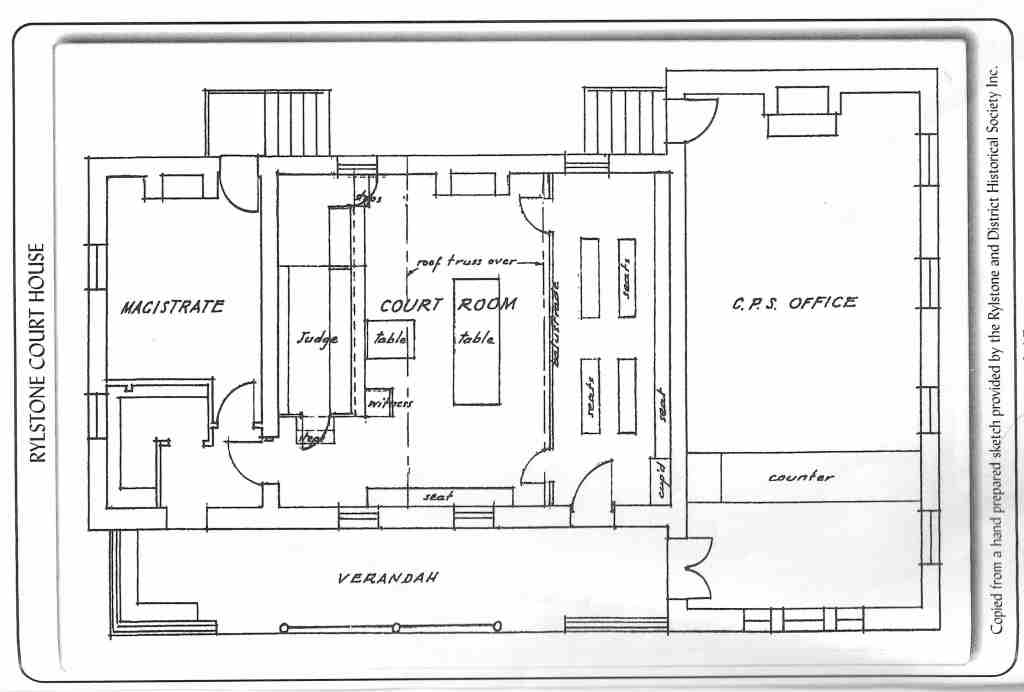
The above-mentioned Sydney Morning Herald article gives a detailed description of the interior of that court house. All fittings and furniture for the court room (30 by 22 feet) and the magistrates’ room (12 by 22 feet) were of French-polished cedar, including the bench, witness stand, dock, cabinets, book-cases and tables. It was carpeted. According to the writer it ‘put our dingy Metropolitan courts in the shade, not excepting even the Central Police Office. I most unhesitatingly award it the palm for being the cheapest piece of Government work I have met with throughout the colony.’ The cost including a buggy shed and other conveniences was £1050.
Historic and Heritage Court Houses in NSW: a Photographic Celebration
by Lachlan Turner 2022
Despite a glowing description and community pride, a dark question mark was attached to the court house build. It was only revealed publicly in 1878, first by Mr Cameron MP in the Legislative Council, then elaborated soon after by George Guile in a letter to the editor of the Sydney Morning Herald. The question was: After George Guile was given the job in February 1871, why were fresh tenders called in October and the job given to William Wadsworth, seemingly a favourite of the Colonial Architect?
George Guile explained that the sandstone that he had sourced locally ‘from the best quarry in the district’ was condemned by the department as not being good enough. Yet the new builder ‘could get no better stone in the district and was allowed to use all the material that I left on the ground which was rejected by the Works Department in my case and approved in his…to this day I have never obtained any redress.’ Well Guile didn’t get justice but he did get vindication.
Confusion about the court house build has more recently come from Lachlan Turner, who published Historic and Heritage Court Houses in NSW: a Photographic Celebration (2022). He lists James McLachlan as the builder, not Wadsworth. I’m afraid I can’t clear that one up.
That’s not the end of the court house story. In 1900 someone convinced the government that the court house wasn’t big enough. Rigby Bros of Bathurst, well-known contractors with a reputation as first class builders, were named the successful tenderers for the additions. These consisted of the imposing gable-shaped rough-coursed portion that contains the words COURT HOUSE. That section became the office of the Clerk of Petty Sessions.
The court house today looks much as it did in 1901, at least on the outside. However it was a much busier building. It was the storehouse of community records: births, deaths, marriages, licenses and registrations. Local appointments, such as Justices of the Peace, Keeper of the Public Pound, Bailiff of the Small Debts Court and trustees of public areas like the cemetery, were made here. Licenses such as for publican, auctioneer, hawker and pedlar, were assessed, granted, renewed and paid for. A small debts court was held monthly, courts of petty sessions more regularly and courts of inquiry under the Lands Act occasionally, as were courts of requests and inquests. Electoral lists were revised and voting was held. Plans and specifications for public buildings could be examined and successful tenders were announced. Today Rylstone court is opened on two Fridays a month.
It seems that Rylstone court house, like other local court houses, were sometimes used for unofficial activities. In 1880 the government forwarded a circular throughout NSW reminding citizens and officers that in the interests of justice: ‘These buildings are not to be used for entertainments or meetings of any kind but reserved for the administration of justice.’


Australian Town & Country Journal 18/10/1884
It is the featured image for the blog ‘In the Interests of Truth and Justice’

 Kandos History
I have always admired that building in Rylstone. It’s certainly one to catch eye somehow. A very interesting and well-researched history.
LikeLike
Thank you Katherine. I appreciate your comments. Yes it is eye-catching. I think it is the contrasting sections.
LikeLike