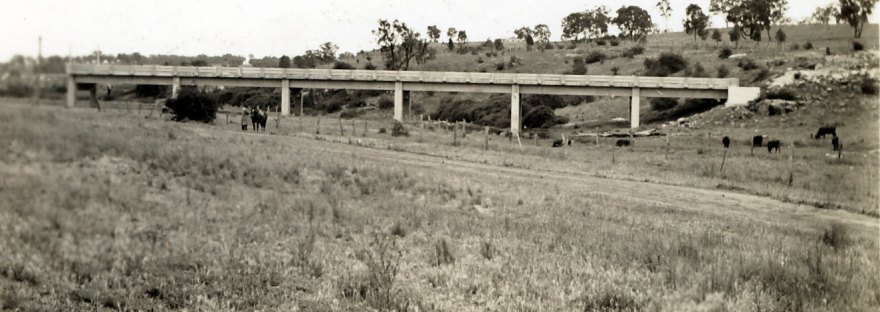
What would we do if suddenly there was no traffic bridge across the Cudgegong at Rylstone? I’ll leave that idea meandering around your brain, while I take you back to a time when there really was no bridge at Rylstone. A roadway led down to a shallow flattish section of river where coaches, wagons and traps trundled across; well-placed stones or a plank or two gave a foot-traveller access; and shepherds or riders on horseback urged mobs of sheep and cattle to clamber up the bank. It wouldn’t do today.
In the first half of the nineteenth century, inland NSW consisted mainly of large sheep runs populated by managers, shepherds and aborigines contesting for land, (squatters were generally overseeing their estates on the other side of the mountains). Rylstone in 1843 hadn’t emerged. It was just a site-plan. But Sir John Robertson’s Crown Land Act of 1861 challenged the squattocracy and opened up the inland to closer settlement and permanent villages and towns. Around that time the Public Works Department was established (1859) and William Bennett began a 30-year tenure as Commissioner and Engineer for Roads and Bridges (1862). By then bridge building was becoming as popular as expressways today.
On 11 October of that year, 300 inhabitants of the ‘usually quiet little township’ (almost the population) celebrated the opening of their ‘beautiful new bridge’ on a ‘gloriously fine’ day when ‘the heavens looked blue and the earth smiled green’. They sat down to ‘a cold collation luncheon at two o’clock, afforded by Mesdames Walton, Taylor and Hardwick’. Miss Walton ‘performed her part of the ceremony in admirable style amidst the plaudits of the assemblage and the bottle of champagne flew into a thousand pieces’. I quote from the Maitland Mercury to try and capture the excitement, festivity and gratitude of the villagers at finally having a bridge.
By the way you might have recognised the name Walton from the Church of England tragedy four years before, when the kindly Mrs Walton lost her life doing a good deed. Her ‘amiable and accomplished daughter’ Mary would soon be married to William Farrar. Her husband John now had a new wife. So life went on.
That was the only celebratory opening of a Rylstone bridge that I could find, though the town would have 3 more traffic bridges, 2 railway bridges and 2 pedestrian bridges. The 1862 bridge, including approaches, cost £1300, was built by Sorrie & Co from Balmain and was a timber beam low level bridge. That was the basic type of colonial bridge, cheap and quick to construct and favoured by a government with limited funds. It was also considered the best choice for slow, light traffic. In fact by the end of the century, 87% of NSW bridges were timber beam. As bridges were built, the demand for goods and services grew in the interior and the population increased. Although the hardwood forests decreased.
Like most NSW rivers, the Cudgegong carries little water in dry seasons but has occasional high, wide floods that shrink rapidly. Five years after the celebration, there was intense rain and flooding. Locals attempted to clear the driftwood, but under the weight of the mass of logs, Rylstone bridge gave way, causing ‘universal regret’.
In April 1869 tenders were called for a replacement bridge and Thomas Heaydon’s tender (he was from Ilford) was accepted. Luckily the government insisted on sureties, so despite Heaydon going broke, the bridge was finished, though it was described as oddly situated due to engineering difficulties. In 1875 this well-built bridge needed repairs. By 1877 someone predicted if it wasn’t fixed it would be coming down about their ears. Who knows what happened in between, but it wasn’t until 1898 that Edward Fitzgerald of Petersham, lauded as a champion bridge builder, one of the best in the colony, was contracted to build the third bridge for £1800. It was completed in August 1899 but there was no ceremony. Approaches were formed and fenced and the old bridge was auctioned off.
A verse in a poem called ‘Rylstone’ written soon after Federation, captured an early morning moment on Rylstone bridge and my interest. (Windsor and Richmond Gazette 24/8/1901)
Away thus early to his farm
The patient husbandman makes start;
The woodman in the morning calm.
Drives o’er the bridge his rumbling cart.
But the modern world was beginning to infiltrate the rural landscape. On 31 August 1924 the Railway Department demonstrated the efficiency of new technology in bridge building. A travelling 100 ton steam crane was hauled along the rail tracks from the locomotive workshops in Bathurst. Between 6am and midday the old timber truss railway bridge was dismantled and new steel girders each weighing 11 tons were strung into position to form a steel bridge. The permanent way was re-laid and the line was ready for the next train, probably that evening. All of this was a source of wonder to the population of Rylstone who watched the process.
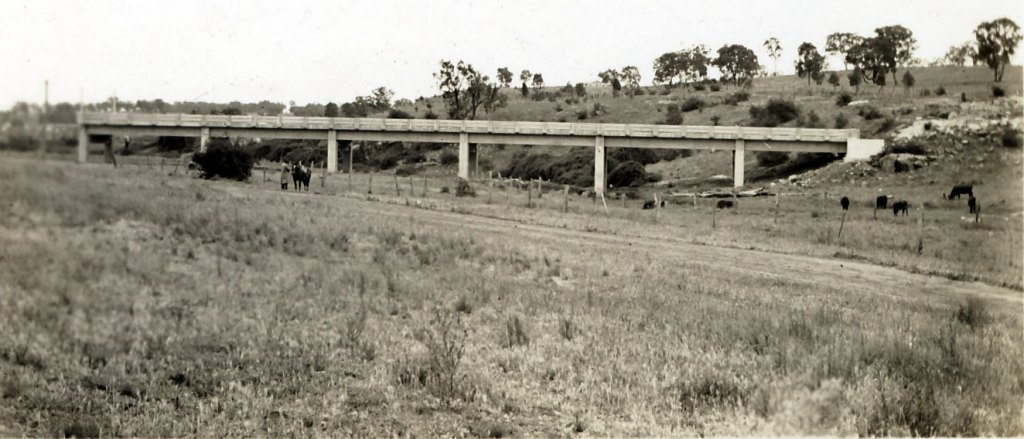
In the meantime the third traffic bridge wasn’t holding up so well. At various times unstable or with loose spikes in the decking or infested with white ants or shaky and rattly, it was finally acknowledged in 1937 that the bridge needed replacement. It was in such poor condition in 1938 that speed was reduced to 5 miles per hour, loads to 3 tons and a notice reminded users ‘This bridge is dangerous’. Not only couldn’t the community agree where the new bridge should be placed, World War 11 interfered. So it wasn’t until 1948 that the new concrete bridge was completed with approaches. It cost £12,000, a quarter of which was paid by Council via a loan.
When I re-discovered Rylstone in the early 2000s, there was a disconcerting sign on the bridge ‘Give Way to Horses’. I thought it should also have ‘and People’. In 2018 MP Paul Toole announced $432,000 funding for a pedestrian footbridge. The steel pedestrian footbridge beside the traffic bridge was completed in 2020. Community health and safety was achieved but there was no celebration.
There is another footway across the river down near the showground, probably installed around the time of the swimming pool. I would like to know more about it. As I would like to know more about John Hawkins, for whom the bridge is now named.

Bathurst MP Paul Toole, Cr Peter Shelley, Council GM Brad Cam and Mayor Des Kennedy showing the footbridge ready for use.

 Kandos History
Very interesting
LikeLike
Thank you Janet. I learnt a lot.
LikeLike
Again great research and interesting – indeed – bridges! Who’d have thought – well, of course – you! Jim
Two typos: (a) 1869 – not 1969 – for replacement of the bridge washed away; After “Give Way to Horses” the “is” should be “it”. (Delete this section of my comment when you adjusted the typos!)
LikeLike
Thank you Jim. I appreciate having a good proofreader who alerts me. I will definitely not delete. I need my typos to remind me to take more care and to remind others they too can critique me. It is the best way of learning. I learnt that in the classroom.
LikeLike
When you have adjusted – see, I’m up for “errors” too!
LikeLike
We do not need a perfect world. How boring it would be.
LikeLike
Thanks Col – it’s ironic th
LikeLike
Thank you Katherine
LikeLike
more information about our Dad John Hawkins can be obtained from his eldest daughter ( my sister) Christine Hawkins by phoning her on 0428 891 938
I found the history on the bridge to be really interesting and informative
LikeLike