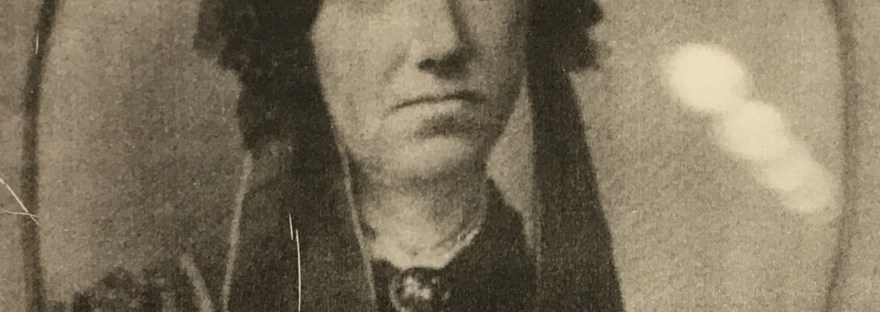
Like most women in the past, Sarah is an obscure figure. She has disappeared from earth leaving a name on a family history chart, three entries in BDMs, a negligible paper trail, a single photo, a small batch of letters that are hard to transcribe, and a husband who didn’t make an impact. But for some reason I want to bring her to life or at least give her substance. She’s connected to me back through the generations as an aunt. And she was a Rylstone ‘farmer’s wife’. That was the ill-defined occupation listed on her death certificate, even though her husband had died 16 years earlier. It seems enough reason for a blog.
That’s Sarah of course in the photo. Is she in mourning? My guess would be yes given the adorned headdress. Certainly it’s a dour expression, some might say sullenly unhappy, but perhaps just melancholic. It might have been taken at the time of her brother George’s death in 1870 when she would have been close to 50. I wish I had another photo. I want to see her happy.
Her birth is listed in NSW BDMs, born to Maria and James Bloodsworth. At that time her father, a son of convicts, was a shipwright and publican, and soon to be a successful butcher and pastoralist with properties at Bathurst, Dabee and Coggan. The records at St Phillip’s Church give greater detail of the births and baptisms of Sarah and her 11 siblings. She, born 14 November 1822 and baptised on Christmas Day, was the 4th child of 7 daughters and 5 sons. The first one, little James, died at 9 months but the rest survived to adulthood. At a time in NSW when many resisted church-going, Sarah’s parents supported the established church and its minister, through subscriptions and attendance. Sarah obviously had some schooling as did her siblings. They learnt to write better than their mother; and Thomas at least, got his education (including Latin) at City Grammar School.
One tread on a paper trail was Sarah’s marriage notice which appeared in 5 colonial newspapers. Aged 17 she married Robert Howe Esq, proprietor of the Sydney Gazette, on 3 September 1840. They were married by special licence. It cost more than an ordinary licence but allowed them to marry when and where they wanted, most likely at the Bloodsworth residence in O’Connell Street. 10 months after their marriage, on Tuesday 6 July 1841, the Sydney Gazette and 3 other newspapers announced the birth of a son at Mrs. R. Howe’s residence, Gazette Office, George Street.
Sarah’s husband Robert Charles Howe, often called Charles I believe, came from a newsprint family. His forebears produced a newspaper at St Kitts in the West Indies where his grandfather George learnt the trade. Returning to England, George worked on various newspapers but also turned to crime, was charged with shoplifting and sentenced to death. Obviously he avoided that and was transported instead. When he arrived in Sydney with his young son Robert, he was put on the government printing press. He was good at that and in 1803 he launched the colony’s first newspaper, the Sydney Gazette, which was taken over by his son, who unfortunately met an untimely death by drowning in 1831. In March 1840, young Robert Charles, aged 20 and soon to be married, was encouraged to begin a career in newsprint by the trustee of his father’s estate, Richard Jones, who bought the Sydney Gazette press for Robert for £1000.
It seemed to be an auspicious beginning for the young couple. You would say they won the lucky dip of colonial life in terms of parents and place. Their generation and their parents’ were referred to as currency lads and lasses. These free young colonials were thriving in the climate and landscape of Sydney, judged to be fitter, healthier and happier than their forbears. As for the colony of NSW, by the 1840s convict transportation was coming to an end and immigrants were bringing new ideas and visions of a better life. Gaslight was in use, steamships were operating, the population had almost doubled in 5 years and wool exports had increased sevenfold in a decade. It was long past being a convict colony.
How quickly life can change. It seemed the boom would never end but suddenly it did. NSW entered a depression. Banks tightened, fear spread, businesses closed, insolvencies increased, including Sarah’s father and husband. Perhaps Robert wasn’t cut out for newspaper work. The Sydney Gazette closed, with Robert owing £341. The government passed legislation to relax the treatment of insolvents and gradually the economy improved. Robert retreated to the McLeay River at Kempsey where he had land. In May 1843 he applied for his Certificate and avoided bankruptcy.
I think he might be the Robert Howe who was exporting agricultural products like wool and tallow in the 1840s. Not just from his own land. Some of Sarah’s family had established successful sheep runs in western and northern NSW. During the period when their first 4 children were born in Sydney, between 1841 and 1848, we can assume they (or Sarah and children at least) were living with Sarah’s parents at O’Connell Street, together with younger siblings. Her sister Maria Coutts, Thomas and children were neighbours. I have been following the Bloodsworth family in the 19thcentury and discovered a family that was close, supportive and affectionate, even though it was gradually spreading to distant parts of the colony.
Between 1850 and 1855 I can place Sarah, Robert and 5 children at Hartley running Howe’s Inn ‘at the foot of Mt Victoria’. Hartley had a population at this time of more than 1000. 12 inns serviced teamsters, bullock drovers and adventurers travelling to the pastoral stations and gold fields beyond Bathurst and Mudgee. Brother George, sister Mary Ann and brother-in-law John Gardiner also had an inn at Hartley.
It is in a batch of letters, held in the Mitchell Library, that I discover a warm, much loved Sally Howe in a cohesive family. On 25th May 1870 Maria her mother writes to her, grieving for her ‘dear unfortunate son’ George, who has unexpectedly died at Rockhampton; and uneasy that the man who went with George cannot be found. She is upset that the parcels she sent Sally haven’t arrived and concerned about Sarah’s scald. She advises her to use goanna oil (almost an immediate cure and the finest thing in the world). She tells Sarah to prepare it from a dead goanna, melting it in the sun just as the Blacks do. She signs off, ‘God bless you all your affectnet Mother Maria Bloodworth’. Sarah’s name-sake and ‘ever affectionate niece’, Sarah M Bloodworth, writes several letters from Merri Merri in 1870 and 1872 telling Sarah about her grief at her father George’s death and also her sister Jane’s. In another letter she light-heartedly discusses the prospects of her girl cousins in the marriage stakes, as well as her own probable engagement.
By 1858 Sarah and Robert had settled on a farm at Dabee Rylstone where their last four children were born. Charles the youngest, born in 1866, brought 25 years of child-bearing to an end, though child-raising continued long after an ailing Robert’s death in 1875 aged 54. I can see why their first child’s birth was trumpeted in 4 newspapers, and why no birth notices appeared for Sarah’s other 8 children, nor death notices for Mary Rebecca aged 6 and a year later William aged 12 months at Rylstone – the uncertainty of the depression, lack of money and little access to newspapers. Of note in 1864 is her daughter Maria’s marriage by special licence to William Highfield. Of note in 1880 is her son Robert’s insolvency as a Rylstone butcher and baker. He too applied for a Certificate and avoided bankruptcy. Ten years later he opened another baker.
Sarah’s family grew and in the end were well-established. Her children in the main married Rylstone locals and lived locally, producing by my estimate 53 grand-children and countless descendants. Sarah died 9 November 1891 aged 68. Her obituary appeared in the Sydney Morning Herald Rylstone Tuesday, ‘Mrs Howe senior one of our oldest residents, died here yesterday from the effects of influenza. A few more cases here are extremely critical.’ She deserved more than that.

 Kandos History
<
div dir=”ltr”>
<
blockquote type=”cite”>
LikeLike
Virginia no message got through but I am glad you are reading the blog.
LikeLike
Hi,
Thank you. I’m sorry my earlier message wouldn’t go through. I wanted to thank you for sharing your articles. I came across your blog while researching family history connected to the Rylstone area. Sarah Howe is actually my great, great grandmother so I was interested to read your latest blog. I have inherited several photos and papers of the Howe, Brown and Bloodworth families. The one I have of Sarah is a full-length photo, from which I believe the photo you shared was taken from. The colouring is much lighter in mine. If you would like a copy of the photo, could you send me your email address and I will send it to you.
Kind regards,
Virginia
LikeLike
Thank you for getting back to me Virginia. Glad you have family history connections. Are you a member of the Bloodsworth Association. I can give you details. They’re meeting in Rylstone later this year. Yes I would love that photo of Sarah Howe. It came from National Library Elsie Watson collection. colosullivan@optusnet.com.au
LikeLike
This is a tender and warm tribute. I admire your doggedness in both tracing the leads and giving personality to your focus in this report. Sarah HOWE (née Bloodsworth). RIP
LikeLike
Many thanks Jim. I appreciate your responses.
LikeLike
A very readable and interesting story about one of the “forgotten women” of a past era. Thanks so much! The photo was incomplete tho.
LikeLike
Thanks Vicki. Yes I take your point. I need more digital assistance. The photos can be a problem.
LikeLike
Thank you for yet again another enjoyable read. What a coincidence for me – at the weekend I began reading David Marr’s Killing for Country where I came across passages on Robert Howe and the Sydney Gazette only to find him again today in your article! Thank you again. Karlyn Robinson
LikeLiked by 1 person
Serendipity Karlyn. Did you note too that Richard Jones (the man who paid £1000 for the Sydney Gazette for Robert) has a very big part in Killing for Country . Connections!
LikeLike
Yes, serendipitous indeed. I love it when that happens. Richard Jones has a high profile throughout the book. I think he was a force to be reckoned with. I have not finished the book, having still some ways to go. I find the subject matter disturbing in parts but am determined to finish it. So many of our ancestors lived through such difficult times in those early days, including Sarah and I admire their survival skills. Karlyn
LikeLike
I found it very distressing and I hope one day to finish it.
LikeLike
as a Howe descendant I found this article very interested
LikeLike
Great to know it reached Howe descendants. Thanks for letting me know Jimlad
LikeLike
Thank you so much, for this story/blog. I am a Howe descendant also, Directly from Sarah as she is my 3rd Great-grandmother on my maternal side.
I am extensively researching my ancestry at the moment and as many of my relatives were from the Kandos, Rylestone, Mudgee, West Wyalong districts I would love to learn much more … LynneD.
LikeLike
Lynne I have gathered material into files but they are too incomplete to make public and I am still working on them. If you are looking for specific information about Sarah let me know and I might be able to help.
LikeLike
I really enjoyed the read thank you
LikeLike
Thanks so much Sheree. I enjoyed learning more about her.
LikeLike