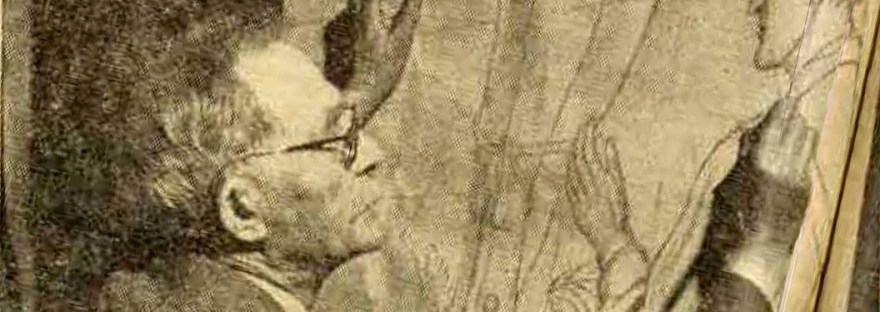
Concealed behind the stained-glass windows of St James Church of England at Rylstone is a Catholic Polish immigrant, John Radecki, an exceptional stained-glass artist. The only clue on the brochure about the creation of the stained-glass windows was a single reference to Ashwin Studio, in relation to the St James window, which commemorates Sarah Louise Willis.
John Radecki at age 20 and fresh from the Mechanic School of Art, where he won a number of prizes, was employed by Frederick Ashwin, who taught him the art and craft of stained- glass design. Radecki was involved at Ashwins for 69 years, as partner, proprietor and chief designer. It was the largest glass-making establishment in Sydney and Radecki’s name appeared on all Ashwin advertising.
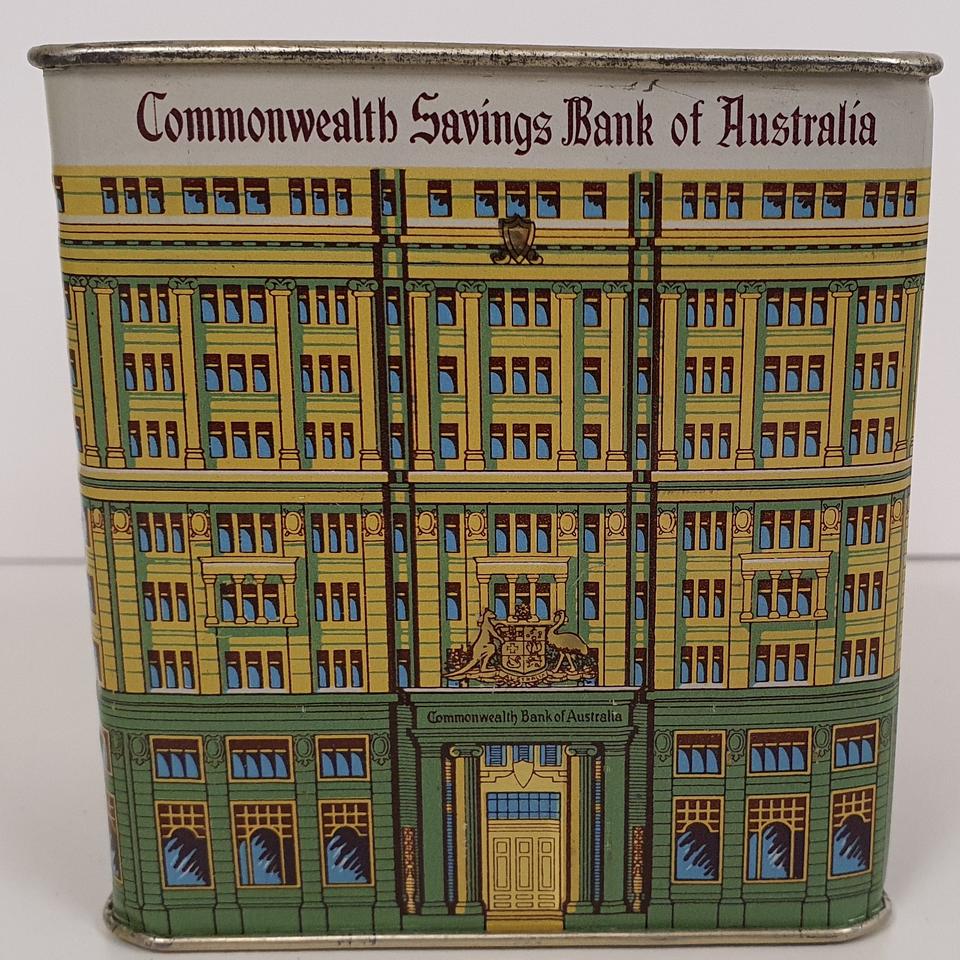
While Radecki’s religious designs can be found in countless churches in Sydney, Newcastle, Wollongong, Canberra and rural NSW, his most applauded secular design was for the vaulted ceiling of the Commonwealth Savings Bank in Martin Place, depicting Australia’s wealth in agriculture, mining, shipping, building and banking. Sadly it is inaccessible to the public. If you don’t know that heritage building you might know the children’s money box that depicted it.
The production of stained-glass windows intrigues me, so I was delighted to discover on Trove, a 1946 article from the Australian Women’s Weekly. Radecki, at 81, was still chief designer and would be for almost another decade. The article enticed me into Ashwin’s premises at 39 Dixon Street near Chinatown and the Markets. It was spread over four levels, accessed by unexpected steps and stairs. In a workshop, craftsmen clad in overalls, were bent over work tables using an assortment of tools. Walls were covered in coloured drawings of saints, animals and patterns. Crates of stained glass, stippled and plain, in a huge range of colours and shades, took up a wall. One man was using a cutting box, illumined from beneath, for tracing patterns and comparing glass samples. One was ‘leading-up’ ie binding pieces of glass with lead cames. One was using ceramic glass-paint for facial expressions, folds in cloth, shadows and highlights. On another table, oil cement was being brushed over a window to ensure water-proofing. In a separate room, glass designs were laid on trays and fired in a kiln for 15 minutes or so, while being observed through a glass panel.
Radecki’s strengths as chief designer, were in all aspects of stained glass: figure drawing, composition, glass painting and use of colour. He was particularly known for realistic hand gestures and facial expressions. Apparently he used the faces and figures of family and friends to depict his subjects. He was once referred to as ‘a designer in leaded glass whose work has made him renowned throughout Australia’. Of interest there are Ashwin windows in the Holy Trinity Anglican church at Kelso described as ‘prized’ and one in St Stephen’s Church Bylong in memory of his friend Private Leslie King.
The ornate borders on five windows at St James point to Ashwins as the producer: St Michael, St John, The Good Shepherd, Consider the Lillies and St James. Though the figures in Eternal Life and I am not Worthy are in the style of Ashwins, the firm had closed by then, so they might have been designed by a former artisan. The abstract pair The Sower and If I Touch Even His garment are too recent and have no similarity. Let the Children Come could be an Ashwin creation despite the lack of a border.
That brings me to Light of the World, the largest window, the oldest, set in the most prominent place behind the altar and, at that time, probably the most recognised. The window is a copy of William Holman Hunt’s painting which in 1906 toured the British Empire and was on display in all capital cities of Australia. It was the subject of sermons, speeches, letters to the editor and news articles. Over 300,000 people saw it at Sydney Art Gallery, which was equivalent to three-quarters of the population of Sydney at that time.
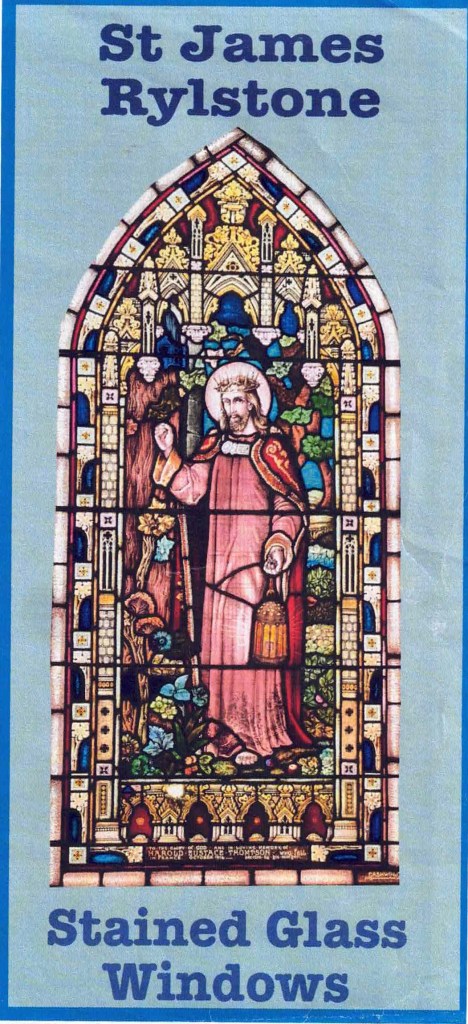
Every window has a story – biblical, familial, local, artistic. Light of the World is detailed and subtle. Jesus stands and knocks at a long-unopened overgrown door, a crown of thorns on his head, a light in his hand. The door which can only be opened from the inside is said to represent the obstinately shut mind. The window was installed in 1920 by James and Kesia Thompson, of the famous Bylong race-horse breeding family, in memory of their son Lieutenant Harold Eustace Thompson who was killed in France in October 1916, and who was known as an outstanding race-horse breeder. I would wager it is a Radecki creation but would like evidence.
Stained glass is architectural. It exists as part of a building. It is also ethereal with its shimmering lights, subtly changing with sun and shadow, taking us out of reality and drawing us into a spiritual world. We see them most in churches. There are still stained-glass windows in English churches which were built in the 7th century. Stained-glass windows throughout the ages were also used to instruct a mainly illiterate congregation.
Today stained-glass windows are devotional and inspiring. This extract from John Oxenham’s poem ‘Adieu! and Au Revoir’ seems to capture the solace of a stained-glass window:
‘Though I come no more
I shall be waiting there to greet you
At His Door.’
The solace is in remembering. And in believing they/you/we will meet again.
In the Women’s Weekly article, John Radecki reminded readers that despite being protected against the weather, stained-glass windows often need attention after about six decades. ‘The job is a long and exacting one requiring the complete taking to pieces of the window and the re-leading of each small section.’
This is true of the windows in St James church – a costly job – needing the generosity of the local community.
Brief Information Chart about the Stained Glass Windows in St James Rylstone
| Subject | Dedicated to | Dedicated by | Date of Dedication | |
| Light of the World | Lieutenant Harold Eustace Thompson | Parents James and Kesia Thompson | 26/2/1920 Bishop Long Mudgee Guardian 5/2/1920 | |
| St James | Sarah Louisa Willis nee Mills | James Willis widower [he died 1942] | Between 1937 and 1942 | |
| Consider the Lilies of the Field how they Grow | Rev Canon John Albert Poole | Isobel Poole [died Oct 1942], son Charles, daughter Eileen (Mrs. Vogler) | Between 1940 and 1942 | |
| St Michael | Flight Lieutenant Clifton Stuart Dunn RAAF; Corporal Andrew Aubrey Dunn AIF | Mr & Mrs Atholstone Andrew Dunn and family of ‘Marlyn’ | Mudgee Guardian 8/1/48 |   |
| St John | Sister Mary Dorothea Clarke, Lieutenant, AAIS | Parents Percival and Flora Clarke, sisters and brother | Mudgee Guardian 8/1/48 |  |
| Let the Children Come | Flight Sergeant D’Arcy Edward Morrison RAAF; His father James Ernest Morrison | Morrison family;wife Leila Mary Morrison | Memorial placed Mudgee Guardian 5/10/1950; Memorial dedicated MG31 May 1951 |  |
| The Good Shepherd | Andrew Dunn; Effie Dunn | Sons and daughters of Andrew and Effie Dunn | Mudgee Guardian 8/1/48 | |
| Eternal Life | John and Dinah Brown | Family | ||
| I am not Worthy | Those who lost their lives in WW11 and Korea | People of Rylstone and district | Unveiled 11/10/1964 by Brigadier FG Gallaghan | |
| The Sower | Percival Henry Clarke; Flora Clarke | Family | 1982 | |
| If I touch even His garment I shall be whole | Atholstone Andrew Dunn; Emily Olivia Dunn; Eric Andrew Dunn | Family | After 1970 |

 Kandos History
Great story, wonderful town! My grandparents moved to Kandos in about 1925. Where would they have stayed while their house was being built?
LikeLike
There was a lot of building going on in Kandos in 1925 including my grandfather’s house in Rodgers Street. Have you checked for their name in Trove? There were a number of boarding houses in Kandos at that time. Also of course the Kandos Hotel. It you get an answer it will be serendipitous.
LikeLike
Brava, Colleen. Excellent piece – including the photo of Radecki himself. A writer and artist friend in Glebe is either a grand-daughter – or more likely the great grand-daughter of Jan Radecki. I have visited his work in the Bank on Martin Place when it was still possible to do so and photographed the large window at Yanco Ag near Leeton – years ago – before realising it was Jan Radecki’s work. When visiting Kandos/Mudgee in 2021 – St James in Rylstone was closed – I was only able to see its exterior. And the Kelso Church you reference has a number of Kables’ graves in the churchyard at the rear. Again I did not know Radecki’s work was there. I have just checked the Wikipedia entry on Jan Radecki, too. And sent a copy of your essay/research to the friend in Glebe – near to St Scholastica’s. (By the way – given your own sterling work on Children’s Picture Books – I think you would be aware of June Factor and her engagement in Children’s rhymes – “Cinderella Dressed in Yella” (with Ian Turner and Wendy Lowenstein) and other books as a follow-up, her Defence of the ABC, involvement with Civil Liberties – her oral history work, too? Anyway – she passed away earlier this month – in Melbourne. I met up with her several years ago at the AGNSW when she was on a visit to see family in Sydney. Jim
LikeLike
Jim I am always impressed by the breadth of your knowledge and contacts. You have such an unflagging engagement with the world. I so enjoyed learning about Radecki and stained glass and am envious that you saw his work in the bank. Yes I knew June Factor’s work; had her books. Some have left my bookcase but I still have Cinderella Dressed in Yella.
LikeLike
Brava, Colleen. Excellent piece – including the photo of Radecki himself. A writer and artist friend in Glebe is either a grand-daughter – or more likely the great grand-daughter of Jan Radecki. I have visited his work in the Bank on Martin Place when it was still possible to do so and photographed the large window at Yanco Ag near Leeton – years ago – before realising it was Jan Radecki’s work. When visiting Kandos/Mudgee in 2021 – St James in Rylstone was closed – I was only able to see its exterior. And the Kelso Church you reference has a number of Kables’ graves in the churchyard at the rear. Again I did not know Radecki’s work was there. I have just checked the Wikipedia entry on Jan Radecki, too. And sent a copy of your essay/research to the friend in Glebe – near to St Scholastica’s. (By the way – given your own sterling work on Children’s Picture Books – I think you would be aware of June Factor and her engagement in Children’s rhymes – “Cinderella Dressed in Yella” (with Ian Turner and Wendy Lowenstein) and other books as a follow-up, her Defence of the ABC, involvement with Civil Liberties – her oral history work, too? Anyway – she passed away earlier this month – in Melbourne. I met up with her several years ago at the AGNSW when she was on a visit to see family in Sydney. Jim (I am reposting – unsure if my first attempt was successful or not.)
LikeLike
Jim apologies this got buried and it certainly didn’t deserve to be. You always post such interesting comments. I envy your sighting of Radecki’s stained glass in the bank. My excuse for tardiness is that I have been bogged down doing an index, corrections, cover choice and of course preparing for the launch – 9/6 4pm at the Kandos Museum if you happen to be in the area.
LikeLike
Colleen: Wish I could be present but not likely – just about then back from a (first) visit to Uluru – to celebrate my 75th on May 29. Best wishes for the launch… Jim
LikeLike
Thank you again Jim you young’un
LikeLike
The interesting thing is that I feel as you jest. (Though I suspect you are pot calling kettle.) New film out (actually two) (a) Kingdom of the Planet of the Apes – wholly shot (some CGI) in NSW – story interesting, landscapes sublime. (b) Juliette Binoche’s “A Taste of Things” – a love story set around food and its preparation and consumption in late 19th century rural France (Normandie, shot in the Loire).
LikeLike
Enjoyed the story. My maternal family include the Bloodworth, Lee, Howe, Highfield, Honeysett and Wiltons. All having a long association with the Rylstone and Mudgee districts.
There is a stain glass window in St Paul’s Presbyterian Church at Mudgee dedicated to William Wilton in memory of some of his grandchildren. It is not as elaborate as the window in your story.
Many thanks for your stories. I always enjoy them and they add some meat to my maternal family history.
Barry Gardner
LikeLike
Thank you Barry. You know we have a few families in common but you have probably accessed those blogs. Sarah Howe is in my sights as a blog subject. I know very little about her but am interested in all Maria Bloodsworth’s daughters.
LikeLike
Thanks for your response. Sarah Howe (nee Bloodworth) is my 2nd Great Grandmother. She married Robert Charles Howe on 3 Sept 1840. Robert Charles Howe,was the grandson of George Howe (Sydney Gazette). Sarah’s sister, Mary married John Andrew Gardiner the brother of her brother, George William’s wife. The Gardiner’s (no known connection to my paternal Gardner’s) history is interesting starting at the Scotch Thistle Inn and Gardners Inn at Blackheath then to Wellington where they owned the property “Gogobolion”. There are so many stories connected to these families. One thar may be of interest is the half sister of Robert Charles Howe, Sarah Donahue. She married a Ferdinand Napoleon Meurant whose father was a convict with an interesting history and being a jeweller/ goldsmith by trade, purportedly made a necklace for Governor King’s wife that enabled him to get an early release and get a land grant at Exetor. The Powerhouse Museum apparently has a gold snuff box attributed to his father. Somethings to whet your appetite.
Regards
Barry
LikeLike
Thank you for the motivation Barry. There is so much inter-weaving among those early families. I feel the Gardiners need a blog one day.
LikeLike
Always love reading your posts.
LikeLike
I always love reading comments like yours Adam. They motivate me.
LikeLike
Thank you Adam I love readers
LikeLike